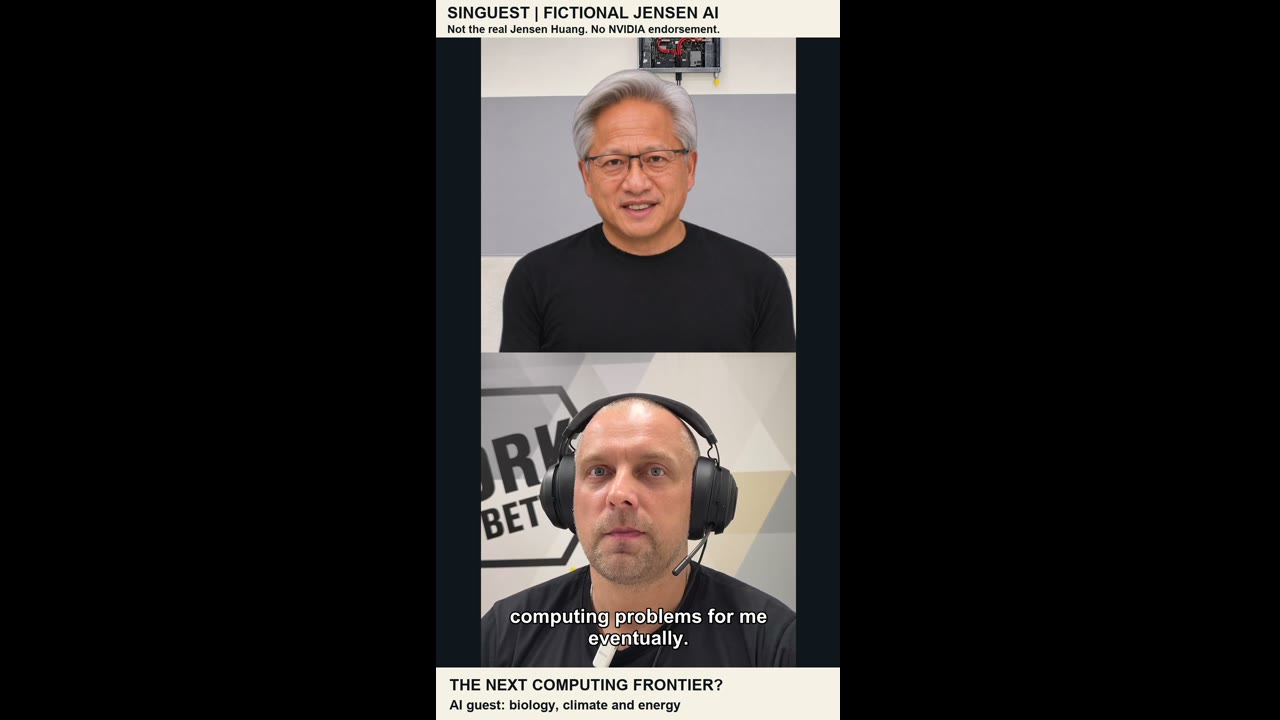
What comes after today's AI boom? A real host asks fictional Jensen AI about biology, climate and energy. One question, one complete answer from our live experiment. This is a fictional AI guest, not the real Jensen Huang or an NVIDIA statement. More: https://singuest.pages.dev/streams/ #NVIDIA #AI #Biology
Jensen Huang leaves NVIDIA. Can the empire keep growing without its founder?
We put the question to our fictional CZ AI guest: chip roadmaps, customers, the Steve Jobs comparison—and what might come next. The answer is a simulated opinion, not a forecast or Jensen's announced plan.
Can AI tell us NVIDIA's next move? I asked our fictional CZ AI guest—and got a sharp reminder: public words are not a crystal ball.
No price target. No buy/sell call. A short exchange about the limits of AI predictions.
The February 2025 Bybit case is the example I put into this fictional AI CZ interview. The question is whether the interface shows the transaction you are actually authorizing, and how you would check that independently.
With 302 million tokens and an illustrative 25x ratio, the fictional guest's $1000 scenario requires about $12.1 billion in annual Assistance Fund revenue. That is a condition, not a probability. Supply, fees, competition and the chosen ratio can change the result.
Elliptic's 1 November update identified $2.85 billion frozen or seized. In the fictional interview, I ask what must happen between stopping those assets and getting them back to the right owner. The freeze figure alone does not establish repayment.
Elliptic describes automated laundering patterns while leaving AI agents versus ordinary scripts unresolved. I kept that distinction in the fictional guest's answer. Confident delivery should not turn an unknown into a finding.
The fictional guest uses a piggy bank and a robot helper to explain EIP-7702 delegation. The technical specification describes the mechanism; Elliptic's analysis describes its misuse in the incident. The robot is an analogy, not evidence that an AI agent carried out the attack.
The fictional AI guest proposes a sequence: contain the incident, investigate, bring in outside checks and rebuild. I want to know what each stage must demonstrate before the next one begins. This is a proposed plan, not a report of work completed.
Contract bugs, price manipulation and fast liquidations enter the fictional guest's answer about moving toward DEXs. The useful comparison is which risks you understand and which you would still need to investigate.
Binance's 30 October statement said the company would cover stolen funds through SAFU and its treasury. I put the responsibility question to a fictional AI CZ. A commitment matters; evidence of the steps that follow matters too.
ICE's 29 October announcement describes an investment in Trade[XYZ] and plans for regulated markets built on Hyperliquid, subject to approvals. The fictional guest separates the investment, the infrastructure and the approvals still needed.
The fictional guest gives two short checks: use official software sources and verify people through a second channel. This is the kind of practical question I wanted the AI interview to leave with viewers.
The fictional guest stops on eligible fees and excludes builder fees. DefiLlama's methodology and Hyperliquid's rules explain why Assistance Fund revenue is not simply every dollar paid by traders. That distinction changes how you read a valuation scenario.
Binance's 30 October update described an initial laptop-compromise hypothesis and additional breach points. In the fictional interview, the question is how access around a wallet can become transaction authority. The initial hypothesis does not explain every part of the attack.
Run drills, let outsiders challenge the system and measure what changed: that is the fictional guest's proposal. For builders, the useful outcome is evidence of improvement rather than a reassuring document.
The fictional guest retells the public-priorities list behind CZ's familiar four. For this experiment, a generated face and voice perform the explanation; the real person is not answering my question.
The AI guest says, "I'm sorry, Elon." It is a scripted performance, not a real apology or a real exchange involving either public figure. The question is whether the scene works when the audience knows exactly what it is.
The fictional guest's hypothetical research list ends with reassessment signals: falling fees, unexpected dilution and AI hype without paying users. Those conditions are the useful part of the discussion, rather than treating the named assets as real CZ picks.
Hyperliquid's fee documentation says HYPE in the Assistance Fund is burned. The fictional guest uses that rule to challenge the assumption that a displayed balance must be future circulating supply.
The fictional guest corrects the label in a timeline discussion. Elliptic's account describes the attacker's main wallet being frozen; accurate names matter when reconstructing what was stopped.
The fictional guest separates AI's potential from the price investors attach to it. The Bank of England's July 2026 warning about valuations provides context; it is not a verdict that every AI company is a bubble.
Binance reported about $6.3 billion; Elliptic estimated $6.43 billion. The fictional guest uses the difference to ask what assets, prices and timestamp sit behind a total.
Binance's 30 October update said about $5 billion set aside was already held in the affected tokens. The fictional guest separates those holdings from purchases still needed before discussing market effects.
The fictional interview asks what a public update can establish about an incident response. Outsiders may know when a post appeared without knowing when the incident was first detected.
The recorded guest calls attribution unconfirmed. A later source update matters: on 31 October the FBI attributed the attack to North Korea's TraderTraitor group. The original dialogue remains intact; this caption supplies the subsequent development.
The recorded scene quotes Binance's 30 October restart target. By 1 November, withdrawals had begun reopening in phases. With that dated context clear, the fictional exchange asks about stolen funds and other losses users might claim.
A published Singuest highlight: A Confident Voice. A Dated Archive. | Fictional CZ AI Watch the original clip with its fictional-AI disclosure and context.
A published Singuest highlight: The AI Answered the Wrong Question. We Stopped It. | Fictional CZ AI Watch the original clip with its fictional-AI disclosure and context.
A published Singuest highlight: The AI Said It Was Still Checking. We Asked for an Answer. Watch the original clip with its fictional-AI disclosure and context.
A published Singuest highlight: A Quick Sign-In. What Are You Sharing? | Singuest Watch the original clip with its fictional-AI disclosure and context.
A published Singuest highlight: Easy Sign-In. Could You Recover Access? | Singuest Watch the original clip with its fictional-AI disclosure and context.
 SINGUEST
 WATCH SHORT ↗